CCfD explained
Carbon Contracts for Difference explained

The funding call is based on the principle of so-called Carbon Contracts for Difference (CCfD), which protect companies against fluctuations in the price of CO2. Conceptually, they are modelled on risk mitigation mechanisms (hedging) used in the financial sector and aim to provide economic security for investments in modern, sustainable and climate-friendly production processes under volatile market conditions. In particular, energy-intensive companies are thus provided with planning and investment certainty for long-term location decisions in Germany.
How it works and its effects
Under the Carbon Contracts for Difference, additional costs incurred by companies over a period of 15 years as a result of using innovative and climate-friendly production processes, compared with conventional reference systems, are offset. Among other things, changes in the price of CO2 and in the costs of certain energy sources are taken into account. In this way, the programme reduces the financial risks that may be associated with the introduction of new production processes and creates a reliable framework for investment.
Carbon Contracts for Difference thus play a key role in bringing innovations into industrial practice at an early stage and in safeguarding the long-term competitiveness of energy-intensive industries. At the same time, they help companies to comply with regulatory requirements relating to climate protection.
Technology neutrality and emission reduction targets
Carbon Contracts for Difference are designed to be technology-neutral. In principle, companies are free to decide which technical solutions to use to modernise their production processes. These may include, for example, electricity, low-carbon hydrogen or biomass. Technologies for carbon capture and storage (CCS) and for carbon capture and utilisation (CCU) may also form part of an eligible production process.
At the same time, the funding call sets out binding requirements for emissions reductions. By the fourth full calendar year following the start of the project’s operational phase at the latest, an emissions reduction of at least 50 per cent compared with the baseline must be achieved. In the final twelve months of the contract period, the emissions reduction must be at least 85 per cent.
Financial support is based on the actual reductions in greenhouse gas emissions achieved compared with the relevant baseline. This ensures that the transition to innovative production processes takes place in line with the climate protection legislation applicable to the industry.
Integration into the market economy and avoidance of double funding
Carbon Contracts for Difference fit within the existing framework of industrial and energy policy. In particular, they complement the European Union Emissions Trading Scheme (EU ETS 1), which uses the price of CO2 to provide economic incentives for reducing emissions. For example, by strengthening Germany’s position as a business location, they help to prevent so-called carbon leakage effects, which arise when production is relocated abroad.
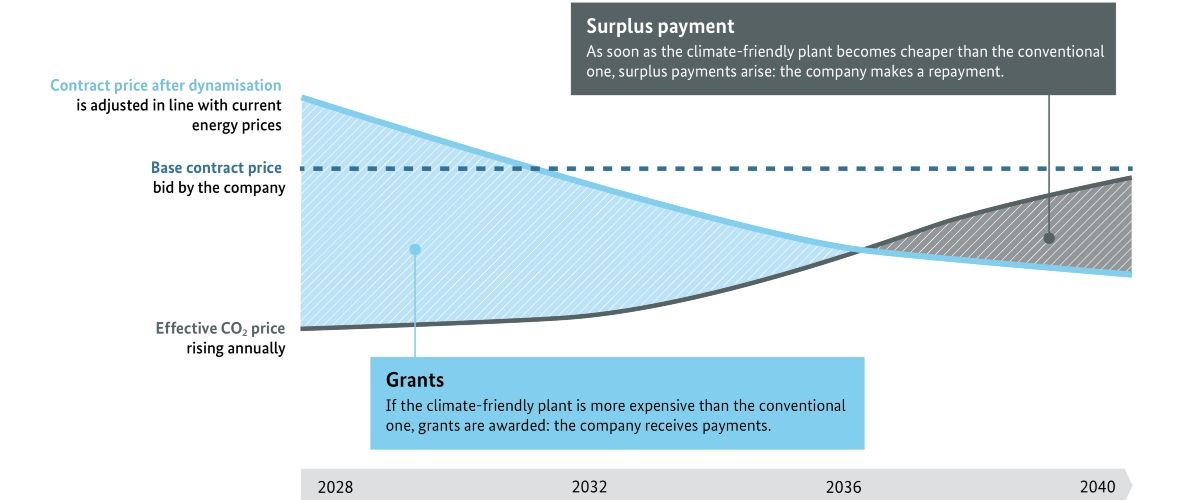
The level of support is variable and linked to changes in the CO2 price. If the CO2 price in EU ETS 1 rises, the government compensation payment is reduced accordingly. If the CO2 price falls, the government compensation may increase in order to continue to ensure the economic viability of innovative production processes. This ensures that the scheme adapts to actual market conditions (see Figure 1).
Figure 1: Graph showing the subsidy linked to changes in the price of CO2 over time
Other state aid for the same investments or costs is permitted only to a limited extent and will be deducted from the aid. This prevents unauthorised double funding and ensures that the scheme complies with state aid rules.
Learning and spillover effects
One of the aims of the funding programme is to facilitate investment in new industrial technologies and to accelerate their market introduction. These include, for example, industrial heat pumps, hydrogen-based production processes and CO2 capture technologies.
This funding enables companies to gain practical experience with new technologies, further develop production processes and improve cost structures. At the same time, positive effects extend beyond individual projects – for example, through the exchange of knowledge, technological learning curves or the establishment of new industrial value chains. These effects can also have an indirect impact at an international level.
In this way, the scheme helps to strengthen the competitiveness of energy-intensive industry as a whole and gives Germany, as an industrial location, a strong position in global competition.
Award procedures and the practical implementation of the funding scheme
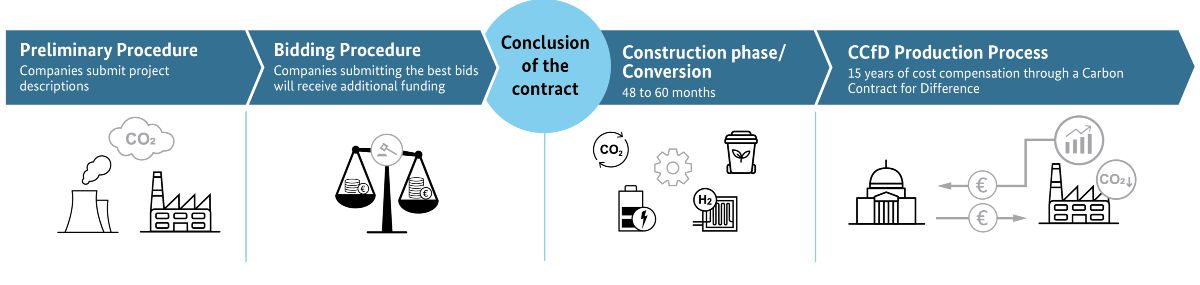
Funding is allocated through a competitive tendering process. The aim of this process is to identify projects that can be implemented with the least possible use of public funds. As part of this bidding procedure, companies submit a bid that includes a base contract price in euros per tonne of CO2 equivalent avoided. This price may take into account both capital expenditure (CAPEX) and operating expenditure (OPEX).
The bids submitted are then assessed on the basis of an overall evaluation. This takes particular account of the project’s funding cost efficiency and the expected reduction in greenhouse gas emissions. On the basis of this evaluation, contracts are awarded in order of the highest scores until the funding volume specified in the call for proposals has been reached. (To find out more about exactly how the bidding procedure works, please watch the video on the left.)
The practical implementation of the scheme is designed to keep the administrative burden on businesses to a minimum. The funding is therefore paid out on the basis of an annual emissions and efficiency report, which is drawn up using data from monitoring carried out under the EU Emissions Trading Scheme.
Figure 2: A diagram illustrating the five phases involved in implementing a CCfD project
Target audience and entry requirements
The programme is aimed at companies in energy-intensive sectors whose production processes fall under the European Emissions Trading Scheme (EU ETS 1). These include, amongst others, sectors such as the paper, chemical, metal, glass and cement industries.
To be eligible for the funding scheme, a project must meet a certain minimum size requirement. The average annual greenhouse gas emissions of the reference system must be at least five kilotonnes of CO2 equivalents per year. As this is a relatively low minimum requirement, the scheme is also suitable for smaller ETS installations. The funding scheme thus addresses a broad spectrum of energy-intensive industries.